


Events
CNIC Launches SciMatrix 1.5—An Independently Developed General-Purpose Multi-Agent Collaboration Platform for Interdisciplinary Research
SciMatrix 1.5 officially launched on November 10. Building on its existing capabilities for research plan discussions, assessment of strategic research frontiers, and science and technology evaluation, the new release introduces three features: Human–AI Interaction, the Agent Discussion Room, and Team Recommendations (Pilot). From participating in discussions and organizing research exchanges to identifying research partners, these features open up new possibilities for interdisciplinary exploration.
SciMatrix is the first general-purpose AI agent-scientist collaboration platform for interdisciplinary research, developed by the Computer Network Information Center (CNIC) of the Chinese Academy of Sciences. The platform is dedicated to building a new research ecosystem characterized by “human–AI integration, multidisciplinary cooperation, and cross-domain synthesis.” The platform brings together 25 AI expert agents representing a range of disciplines, providing professional support for interdisciplinary research and collaboration through the exchange and integration of diverse disciplinary perspectives.
Human–AI Interaction
Interrupt responses and request revisions to bring expert judgment into the discussion
Interdisciplinary discussions often involve additional information about research conditions, adjustments to the scope of a problem, and the emergence of new ideas. Timely intervention by researchers helps realign agents’ analyses and advance the discussion.
Human–AI Interaction allows researchers to interrupt an agent’s response at any time and request revisions to specific content, bringing their expert judgment into the discussion. If an agent misunderstands the problem, or if the research task requires additional constraints, researchers can provide further requirements to guide subsequent analysis.
For example, researchers can specify particular experimental conditions during a research plan discussion or shift the analytical focus to a particular application scenario. The relevant agents can then adjust their analyses to reflect the new requirements and continue the ongoing discussion.
From framing questions to revising ideas, researchers can continuously contribute their expert judgment to agent collaboration, keeping discussions closely aligned with practical research needs.

SciMatrix interface for agent responses and revisions
Agent Discussion Room
Select agents and organize roundtable discussions flexibly
Different research questions call for different disciplinary perspectives. Some require an in-depth exchange on a specialized issue, while others benefit from contributions across disciplines to explore new research directions.
The newly introduced Agent Discussion Room allows users to select one or more disciplinary agents and flexibly organize specialized or interdisciplinary discussions around their research topics and discussion needs.
Users can select a single disciplinary agent for an in-depth exchange on a specific question. Alternatively, they can invite agents from multiple disciplines to present their analyses and perspectives on the same topic within a shared conversation. This makes it easier to compare disciplinary priorities and generate new research ideas.
For example, researchers developing sustainable materials can invite agents specializing in physics, chemistry, materials science, and ecology to examine material structures, fabrication methods, performance evaluation, and ecological impacts, exploring design approaches that address both performance and environmental requirements.
From refining initial ideas to exploring interdisciplinary research directions, the Agent Discussion Room provides a more flexible way to organize research exchanges as needed.
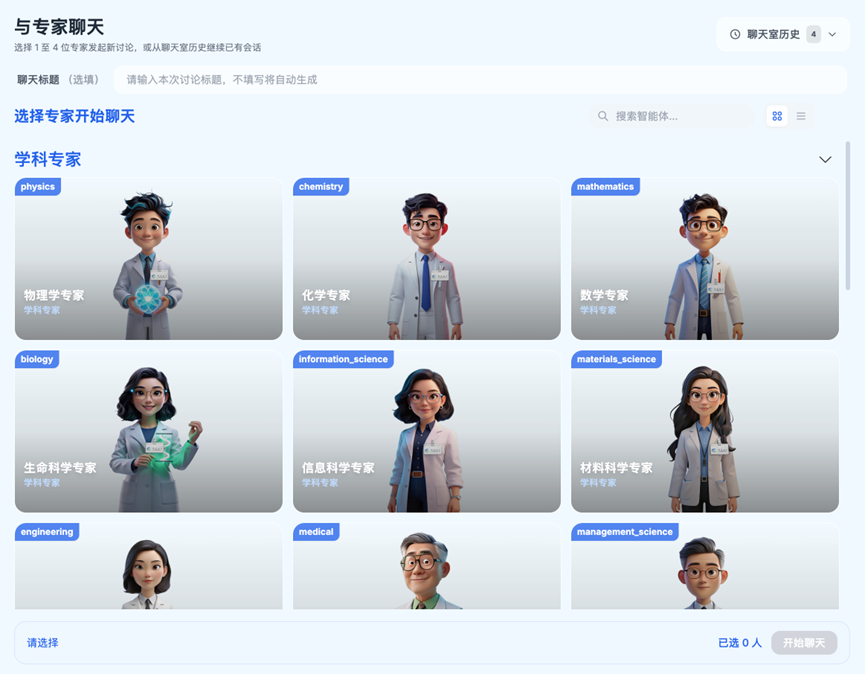
Expert agent selection interface in the SciMatrix Agent Discussion Room
Team Recommendations
Draw on multiple disciplines to identify suitable research partners
Advancing interdisciplinary research requires not only knowledge and methods from different fields, but also the participation of researchers with relevant expertise. Identifying expert teams that match a project’s needs is an important step.
SciMatrix has introduced Team Recommendations, currently in its pilot phase. AI agents from multiple disciplines jointly analyze project requirements and consider relevant criteria to recommend candidate experts for research collaboration.
After users enter a project title, research description, and objectives, agents from different disciplines draw on their respective expertise to recommend candidates from an expert database. Through discussion and a comprehensive candidate selection process, they produce a list of recommended expert teams and can also provide the reasons for their recommendations.
Involving agents from multiple disciplines helps broaden the range of perspectives and identify the complementary expertise a project may require. The recommendations can inform the search for research partners and the formation of project teams.
From discussing research ideas to identifying potential collaborators, Team Recommendations supports the further development of interdisciplinary research.

SciMatrix Team Recommendations interface
SciMatrix 1.5 is now available. Log in to explore the new experience of interdisciplinary multi-agent collaboration.
Access the platform: https://www.scimatrix.cn/
Access will be granted in stages shortly to users who have already requested a trial. Please check your email for updates. New users who wish to apply for a trial should email scimatrix@cnic.cn with a brief description of how they plan to use SciMatrix. Thank you for your patience and support.

 Address: CAS Informatization Plaza No.2 Dong Sheng Nan Lu, Haidian District, Beijing 100083, China
 Tel: 8610-58812266
