
Good News | CNIC’s Research Team Receives the IEEE CG&A 2025 Best Paper Award
The IEEE Computer Society recently announced the winners of its 2025 Best Paper Awards. The paper “AuraGenome: An LLM-Powered Framework for On-the-Fly Reusable and Scalable Circular Genome Visualizations,” jointly completed by the Department of Advanced Interactive Technology and Applications at the Computer Network Information Center (CNIC), Chinese Academy of Sciences, and the Beijing Institute of Genomics, Chinese Academy of Sciences (China National Center for Bioinformation), was named the sole Best Paper Award Winner of IEEE Computer Graphics and Applications (IEEE CG&A) for 2025. Master Student Chi Zhang is the first author; Assistant Professor Yu Dong is co-first author; and Senior Engineer Yang Wang is the corresponding author.
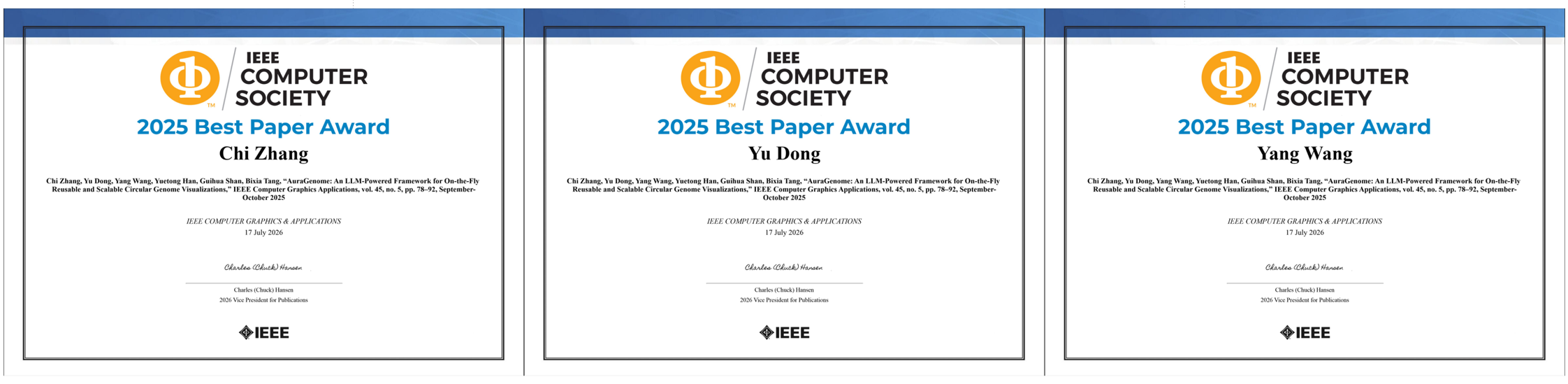
IEEE Computer Graphics and Applications is a leading international journal published by IEEE in the fields of computer graphics and visualization. Its Best Paper Award is selected jointly by the IEEE Computer Society Publications Board and the journal and recognizes research from the past year that stands out in technical quality, originality, and impact on the field. IEEE CG&A published 68 papers in 2025, giving the award a selection rate of 1.47%.
The award-winning paper targets long-standing pain points in genomic data visualization—complex scripting, costly manual configuration, and results that are difficult to reuse—and introduces AuraGenome, an LLM-driven framework for the intelligent generation of circular genome visualizations. The framework brings the semantic understanding of large language models together with a multi-agent collaboration mechanism, allowing researchers to turn natural-language analysis requests into interactive, reusable, and extensible multi-layer circular genome visualizations within minutes.
AuraGenome breaks away from the conventional “manual configuration – scripting – static output” workflow and establishes a novel framework built on “natural language – agents – interactive analysis.” It supports a range of representations, including circular, radial, and chord layouts, and offers interactive refinement, configuration reuse, and visualization export—making it far easier to transfer and reapply complex genome visualizations across different genomic datasets and analysis tasks.
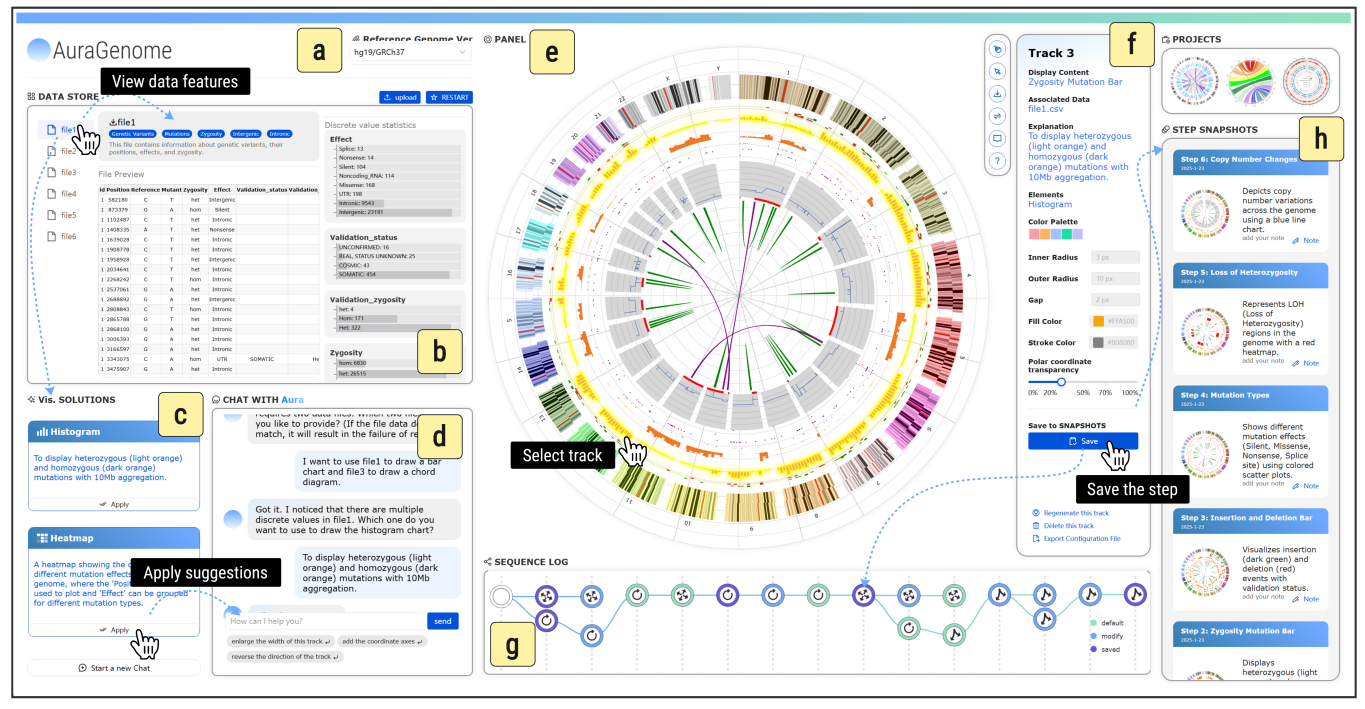
In practice, experts used AuraGenome to analyze chromosomal translocations in acute myeloid leukemia, producing a joint visualization of structural variants and transcriptional levels in 20 minutes and interactively identifying and annotating regions containing potential biomarkers. In a task reproducing the COLO-829 melanoma mutation landscape, the framework recreated the complex interactive visualizations of the original study with high fidelity in just seven minutes. Comparative experiments against Circos, a widely used tool for circular genome visualization, showed that AuraGenome improved task efficiency by 69% and achieved an accuracy of 89%. By substantially lowering the barrier to using sophisticated genome visualization tools, it allows researchers to devote more of their attention to data analysis and the scientific questions themselves.
The IEEE CG&A Best Paper Award is a strong endorsement of the team work on LLM-driven scientific data visualization and intelligent interaction. Going forward, the team will continue to address the demands of complex data analysis and visualization in scientific research, exploring a deeper integration of large language models, agents, and visual analytics to advance scientific visualization toward a more intelligent, efficient, and reusable paradigm for research analysis.
This work was supported by the STI 2030—Major Projects program (2021ZD0200200) and the Beijing Natural Science Foundation Youth Science Fund (4254090).
Paper information:
Chi Zhang, Yu Dong, Yang Wang, Yuetong Han, Guihua Shan, and Bixia Tang. “AuraGenome: An LLM-Powered Framework for On-the-Fly Reusable and Scalable Circular Genome Visualizations.” IEEE Computer Graphics and Applications, 45(5): 78–92, 2025. DOI: 10.1109/MCG.2025.3581560