
CNIC Achieves Progress in Quantum Computing Error Correction Research
Currently, popular Noisy Intermediate-Scale Quantum (NISQ) computers face two core challenges in molecular simulation: limited quantum circuit expressibility and hardware noise interference.
A research team involving the High Performance Computing Department of Our Center adopted a classical post-processing approach. They imposed strict physical constraints (i.e., N-representability conditions) on the "two-electron reduced density matrix" measured by quantum devices and introduced norm-based distance constraints. This ensures that the corrected results not only comply with physical laws but also maintain consistency with the original experimental data.
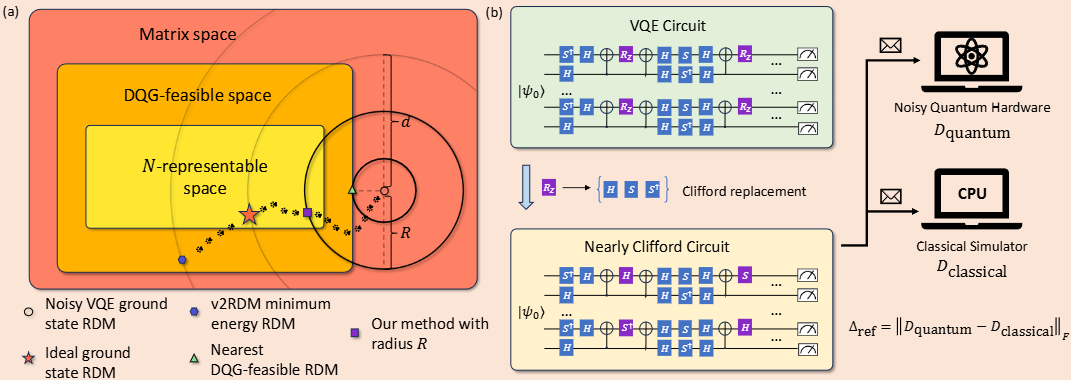
Error Correction Scheme Based on Distance Constraints and N-Representability
In numerical simulations, this method achieved chemical accuracy close to "Full Configuration Interaction" for the ground-state energies of H2, LiH, and linear H4 molecules, significantly outperforming traditional Variational Quantum Eigensolvers (VQE) in noisy environments. Furthermore, the team successfully applied this framework to denoise Ultrafast Electron Diffraction (UED) signals of C6H8 molecules, demonstrating its applicability in predicting complex experimental observables.
The related research results have been accepted and published in Phys. Rev. Applied (CAS Q2 / Xinrui Q2, IF=4.4). The co-first authors are Dr. Qi-Ming Ding from the Center for Frontiers in Computing Studies at Peking University, and Dr. Jiawei Peng from South China Normal University (a visiting scholar at Our Center during the research, currently a postdoctoral fellow at the University of Hong Kong). Dr. Yingjin Ma, Associate Researcher at the Center, serves as a co-corresponding author.
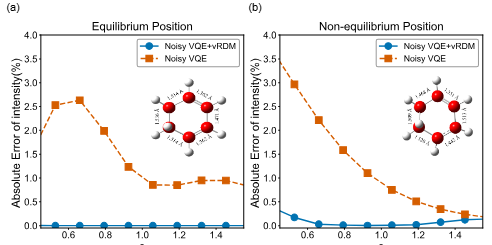
Signal Denoising Applied to Ultrafast Electron Diffraction Simulations
The study received support and assistance from collaborating researchers at the China Academy of Engineering Physics, Beijing Normal University, the University of Cambridge (UK), and others. It was also supported by the National Security Academic Fund, the National Natural Science Foundation of China, the Strategic Priority Research Program of the Chinese Academy of Sciences, and the Youth Innovation Promotion Association of the Chinese Academy of Sciences.
Related Results:
[1] Obtaining accurate ground-state properties on near-term quantum devices, Qi-Ming Ding#, Jiawei Peng#, Junxiang Huang, Yukun Zhang, Huiyuan Wang, Xiaosi Xu, Jiajun Ren, Yingjin Ma*, Xiao Yuan*, Phys. Rev. Appl. https://doi.org/10.1103/lx3w-w6jx.