
Our Center Has Made Progress in Attention Regulation Mechanisms for Large Language Models
In recent years, large language models (LLMs) have achieved significant progress in tasks such as natural language understanding and intelligent analysis. However, during the reasoning process, they still commonly suffer from attention allocation bias, which causes the model to overly focus on tokens with low semantic value, thereby affecting the semantic consistency and stability of reasoning results. With the widespread application of large models in practical scenarios such as network security and log analysis, how to improve the semantic reliability during inference without introducing additional training cost has become a key problem that needs to be urgently addressed.
To address the above challenges, the research team proposed a plug-and-play attention optimization method, PAOSC (Plug-and-play Attention Optimization for Semantic Consistency). Without changing the original model structure, this method dynamically adjusts the attention distribution during the inference stage. It can effectively suppress the interference of low-value tokens and guide the model to focus on key information, thereby improving inference efficiency while enhancing semantic consistency. Experimental results show that this method achieves stable performance improvements across multiple mainstream large models and various tasks.
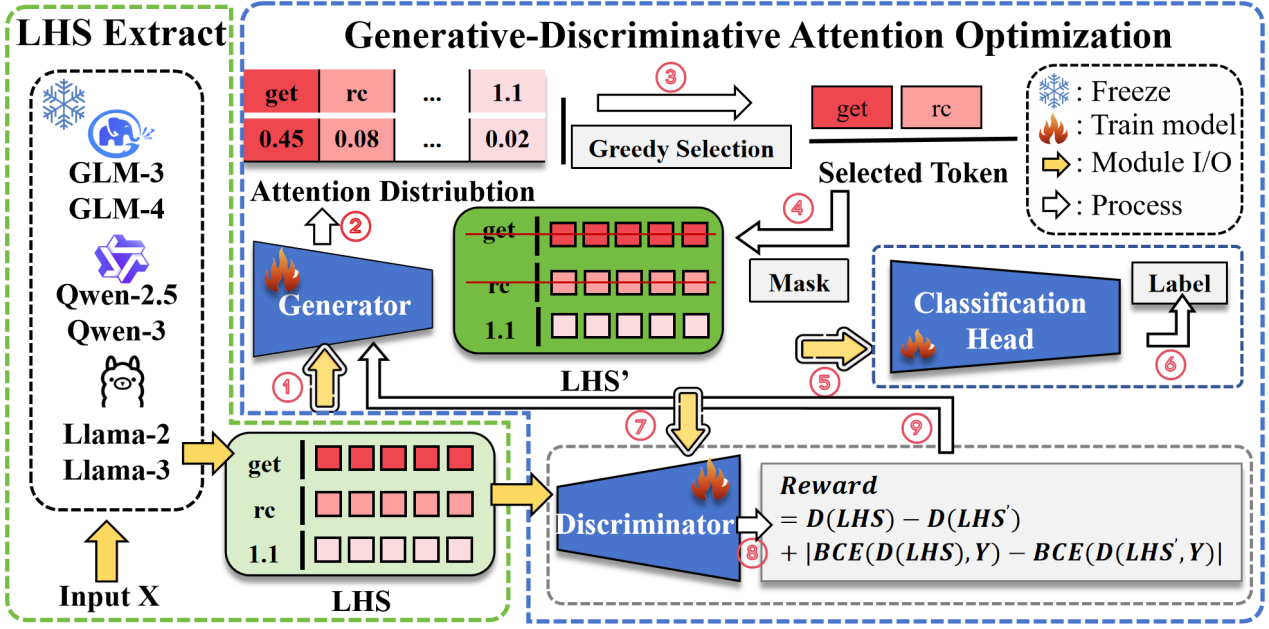
PAOSC Model Structure Diagram
The related research results have been accepted by the top conference in the field of computer and information science, The Web Conference 2026 (WWW 2026). This work was supported by the National Key Research and Development Program of China (2023YFC3304704), providing a new technical approach for improving the controllability and reliability of large models during inference. The first author of the paper is Chang Li, a PhD student at our center, and the corresponding author is Senior Engineer Chun Long.