
CNIC Makes Progress in High-Performance Computing for Spin-Orbit Coupling Effects
The spin-orbit coupling effect (Spin-Orbit Coupling, SOC) is a core phenomenon in relativistic quantum mechanics and has been widely used in modern magnetic recording media and topological materials.
Recently, the High Performance Computing Department of our Center made progress in the quantitative calculation of spin-orbit coupling effects. Reliable calculation of spin-orbit coupling depends on an accurate description of the strong-correlation effects and relativistic effects in the system being calculated. To address this challenge, the research team combined its self-developed density matrix renormalization group (DMRG)-based reference-state reconstruction, externally contracted multireference configuration interaction (ecMRCI) dynamic-correlation treatment, and spin-orbit coupling (SOC) calculation. The team established a streamlined DMRG2sCI-ecMR-SOC computational workflow and, through deep optimization for high-performance computing, achieved efficient computation on modern heterogeneous HPC clusters.
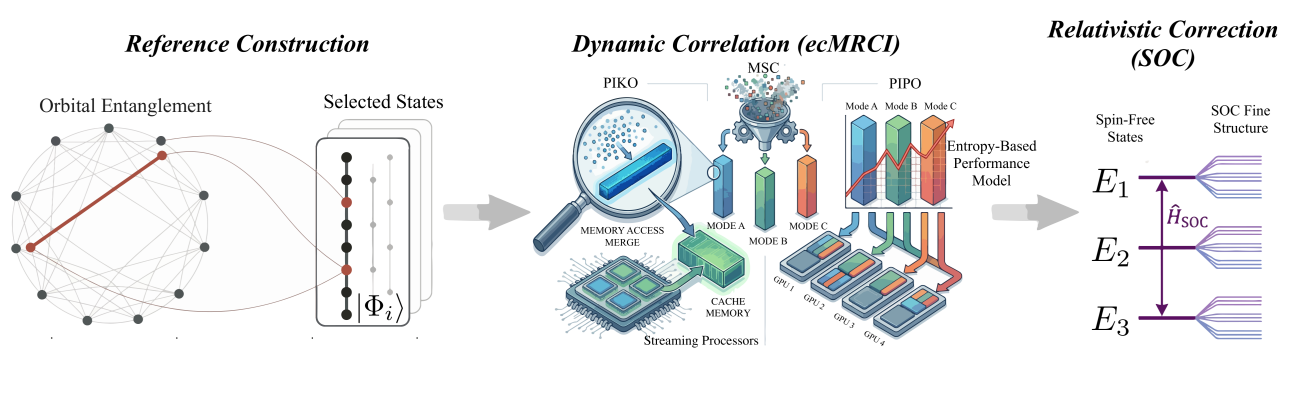
Schematic diagram of the DMRG2sCI-ecMR-SOC computational workflow
The study proposed a physics-informed kernel optimization strategy, PIKO (Physics-Informed Kernel Optimization), and a parallel optimization strategy, PIPO (Physics-Informed Parallel Optimization). The research also calculated the electronic-state energy levels of rare-earth terbium (Tb) ions and the magnetic-property g tensor of TiF3, a representative strongly correlated magnetic molecule. The results agree well with experimental data and are significantly better than density functional theory (DFT) results reported in the literature.
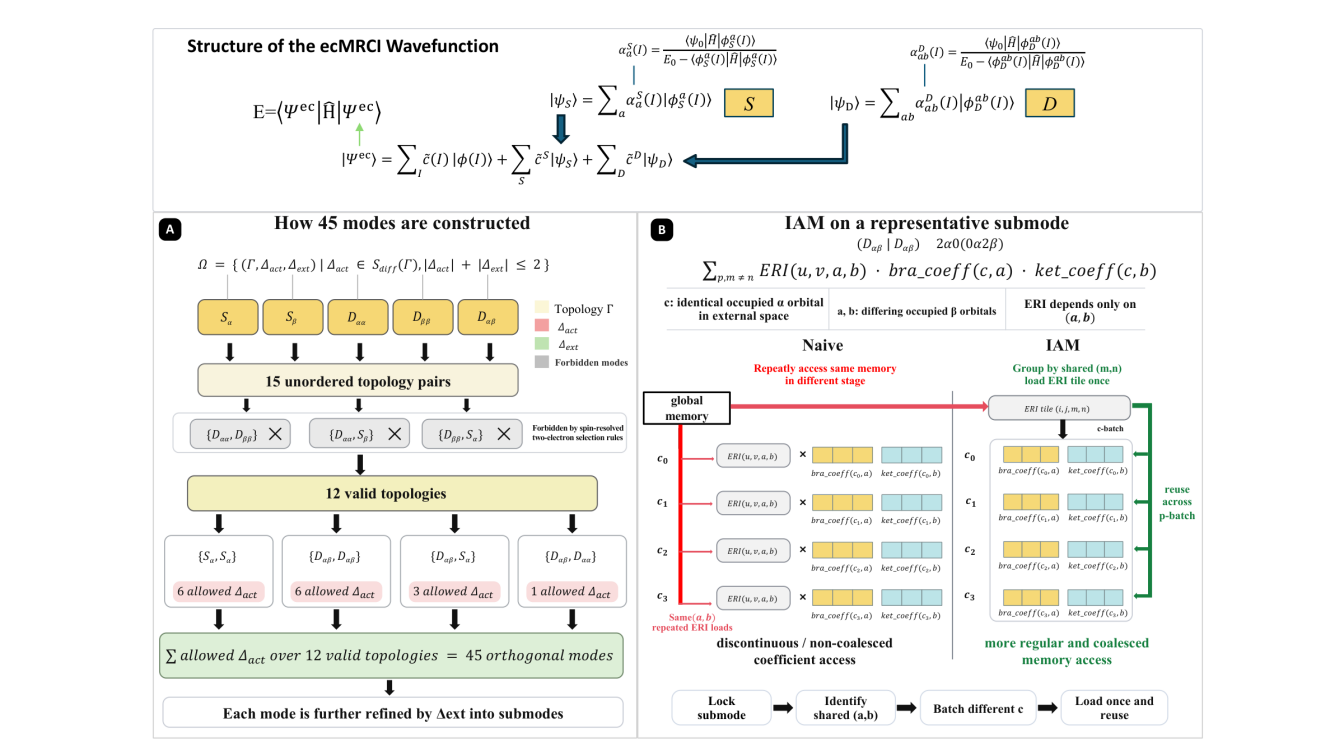
Schematic diagram of physics-informed software-hardware co-optimization
The related research results were accepted by the American Chemical Society journal The Journal of Physical Chemistry Letters and were also included in the "Future Leaders in Physical Chemistry" special issue. The co-first authors of the paper are Runfeng Jin, a doctoral student at our Center, and Chen Li, a master's student at our Center.
This work was supported by the National Key R&D Program of China, the National Natural Science Foundation of China, the Strategic Priority Research Program of the Chinese Academy of Sciences, and other funding, and it also received support and assistance from collaborating researchers at Shandong University. The related calculations were mainly completed on the "Dongfang" and "Yuan" high-performance computing clusters.
Related Link
Scalable and Physics-Informed Multi-Reference Implementation with Spin-Orbit Couplings via Modern HPC Clusters. Runfeng Jin#, Chen Li#, Xinyu Sun, Wenhao Liang, Lianhua He, Haibo Ma, Jun-Bo Lu*, Zhong Jin*, and Yingjin Ma*. The Journal of Physical Chemistry Letters, https://doi.org/10.1021/acs.jpclett.6c01503.