


Research Progress
Our Center Has Made Progress in Verifiable Blind Quantum Computing
In recent years, quantum computing, owing to its advantages in computing power and information storage, has attracted widespread attention in fields such as cybersecurity, artificial intelligence, life sciences, and financial analysis. However, universal quantum computing devices are difficult to build and maintain, making blind quantum computation (BQC) a more practical form of realization: a resource-limited client can delegate the main computing tasks to a powerful quantum server while revealing minimal information. Measurement-based quantum computation (MBQC) is an important framework for realizing BQC, and hypergraph states are key resources widely used in it. Verification of hypergraph states is a core step in guaranteeing the validity of MBQC. However, existing verification protocols for hypergraph states generally face a dilemma between efficiency and robustness: highly robust protocols often incur huge overhead, while low-overhead protocols find it difficult to tolerate errors and are not sufficiently practical.
To address the above challenges, the research team proposed a novel verification protocol for general hypergraph states. By integrating hypergraph coloring and stabilizer test to obtain the method called the color test, the protocol achieves a favorable trade-off between efficiency and robustness while maintaining sufficient fidelity. Specifically, the protocol is applicable to general hypergraph states and is not restricted by the number of qubits or the entanglement structure; the client does not require quantum memory, does not assume that the state satisfies the independent and identically distributed property. Theoretical analysis shows that the protocol reduces the overhead to  while maintaining a fault-tolerance rate of
 , where
 denotes the number of qubits in the hypergraph state and
 denotes the number of colors in the hypergraph. Compared with existing representative protocols, this protocol achieves a more favorable balance between efficiency and robustness: compared with highly robust protocols, its overhead is significantly reduced; compared with low-overhead protocols, it can tolerate a certain level of errors and is more practical; and compared with existing trade-off protocols, it has lower overhead and higher robustness.
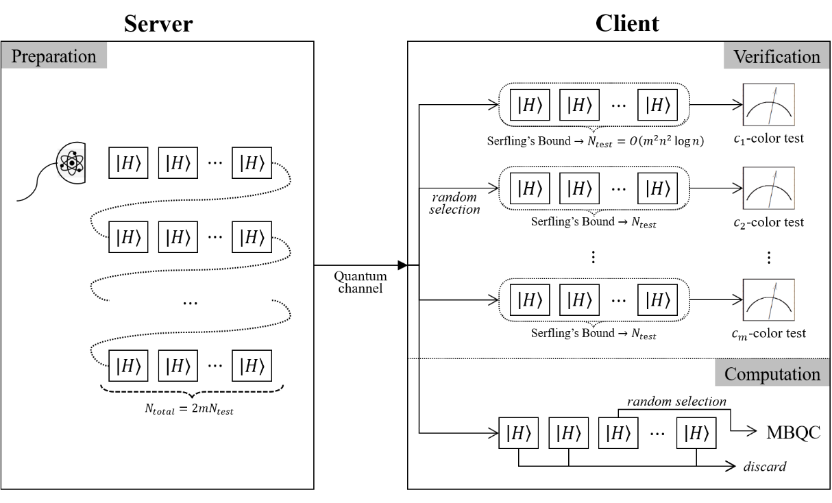
Framework of the verification protocol
The related research results have been accepted by The Computer Journal, a CCF-B journal in the field of computer and information science. This work was supported by the Research Program of Chinese Academy of Sciences on Cyber Security and Informatization (CAS-WX2022GC-04) and the National Key Research and Development Program of China (2023YFC3304704), providing new technical ideas for improving the efficiency and robustness of hypergraph state verification in blind quantum computation and for verifiable MBQC applications. The first author of the paper is Zimeng Yuan, a PhD student at our center, and the corresponding author is Senior Engineer Chun Long.

 Address: CAS Informatization Plaza No.2 Dong Sheng Nan Lu, Haidian District, Beijing 100083, China
 Tel: 8610-58812266
