


Research Progress
Progress in Malicious Encrypted Traffic Detection Technology
With the large-scale popularization of encryption protocols such as TLS/SSL and HTTPS in recent years, the proportion of encrypted network traffic has continued to increase. Malicious software frequently conceals its behaviors through encrypted channels to evade detection by traditional traffic inspection methods. Existing malicious encrypted traffic detection approaches are mainly divided into two categories: packet-level and flow-level methods. Packet-level schemes analyze individual packets in isolation and fail to capture continuous abnormal behavior chains across multiple packets. Flow-level methods can characterize the overall statistical distribution of traffic yet weaken the feature signals of local abnormal packets through aggregation operations. Furthermore, most advanced attacks are constructed by legally formatted single packets but violate inherent protocol logic in their overall interaction sequences, leading to a critical limitation of feature disconnection between packet-level semantics and flow-level context in current detection models.
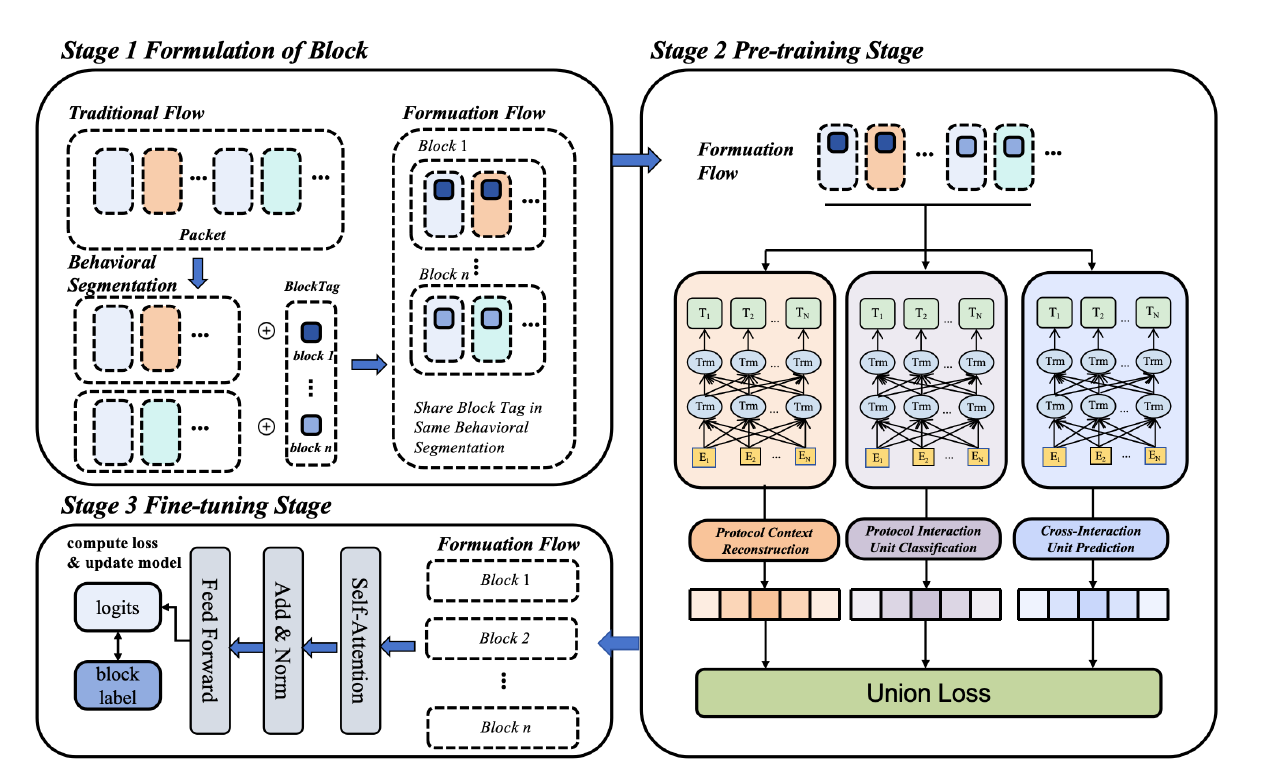
Framework of BLOCK-BERT
To address the above technical challenges, the cybersecurity research team of our center proposes a novel detection model named BLOCK-BERT. This method defines a BLOCK protocol behavioral semantic unit, which divides raw encrypted traffic into standardized interaction stages including connection establishment, security negotiation, data transmission, and connection termination. This design enables comprehensive modeling of behavioral chains and cross-packet dependencies within encrypted sessions. On this basis, the BLOCK-BERT model designs three self-supervised pre-training tasks: protocol context reconstruction, protocol interaction unit classification, and cross-interaction unit prediction. The model can effectively learn standard protocol interaction logic with minimal labeled data. In the fine-tuning phase, an RFC specification constrained attention mechanism is further introduced. By embedding legitimate protocol state transitions and compliant operation sequences as prior knowledge into the attention matrix, the model effectively reduces misjudgments of illegal protocol interactions and significantly improves detection robustness. Experimental results on the Datacon-2020 dataset demonstrate that the proposed model achieves an accuracy of 99.04% and an F1-score of 99.03%, outperforming the state-of-the-art baseline models by 5.94 and 5.22 percentage points, respectively.
The relevant research findings have been accepted by Computer Networks, a top-tier journal in the field of computer networks, which is classified as a JCR Q1 journal and a CCF Category B journal. The first author of the paper is WANG Yaohui, a doctoral student at our center, and the corresponding author is Senior Engineer LONG Chun. This work was jointly supported by the Basic Research Program of the Computer Network Information Center, Chinese Academy of Sciences (No. 2026QYJS02) and the Youth Innovation Promotion Association of the Chinese Academy of Sciences (No. 2023181).
Related Achievement:Yaohui Wang, Degang Sun, Wei Wan, Jing Zhao, Guanyao Du, Chun Long*, “When BERT Meets BLOCK: A Pre-training and Fine-tuning Malicious Encrypted Traffic Detection Method Based on Protocol Semantic Units,” Computer Networks, 2026.

 Address: CAS Informatization Plaza No.2 Dong Sheng Nan Lu, Haidian District, Beijing 100083, China
 Tel: 8610-58812266
