


Research Progress
Our Center Has Made Progress in Privacy-Preserving Federated Learning Technology
In recent years, Federated Learning has been widely applied in fields such as the Internet of Things and finance. However, its collaborative mechanism of model uploading and parameter aggregation may still leak client privacy through model updates, while global models also contain important intellectual property. In addition, existing privacy-preserving schemes rely heavily on cryptographic techniques, imposing high computational and communication overhead on resource-limited clients.
To address these challenges, the research team proposed CAR-PPFL, a client-key-free privacy-preserving federated learning framework. Based on a dual-server architecture, the framework transfers computationally intensive operations from clients to the server side through a Masking-then-Crypto (MtC) protocol, while using a compact SIMD encoding method to improve communication efficiency. Experimental results show that, while maintaining model utility, CAR-PPFL effectively protects the privacy of client updates and the global model and significantly reduces the computational and communication burden on resource-limited clients, providing a new technical approach for deploying federated learning in practical scenarios.
The research has been accepted by Future Generation Computer Systems (CAS Journal Ranking: Category 2; JCR Q1). The first author is Haojie Nie, a master's student at our center, and the corresponding author is Professorate Senior Engineer Chun Long. This work was supported by the National Key Research and Development Program of China (2023YFC3304704).
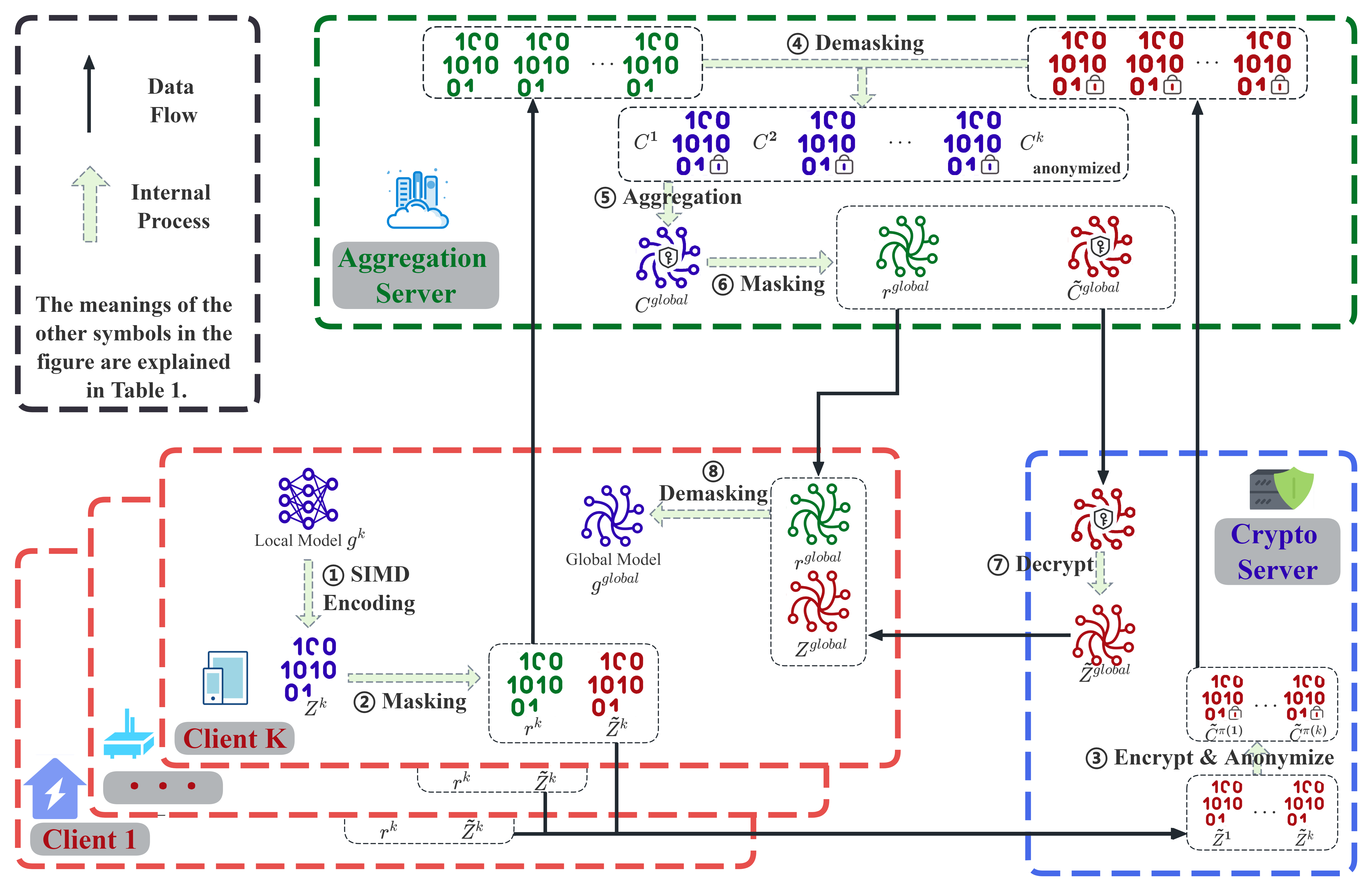
CAR-PPFL Framework

 Address: CAS Informatization Plaza No.2 Dong Sheng Nan Lu, Haidian District, Beijing 100083, China
 Tel: 8610-58812266
